
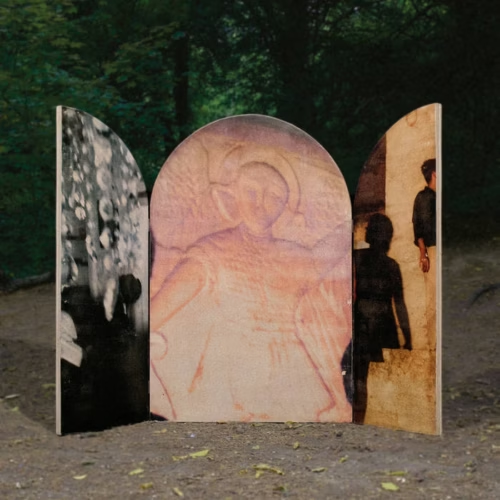
It’s not often an art-rock record arrives scented with salt air and sun-bleached stone. But that’s part of the intrigue behind Only You Left, the latest from West Yorkshire trio The Orielles, a band that has spent the past few years steadily pushing beyond anything typically filed under “indie.”
The band first gained wider attention with 2018’s Silver Dollar Moment, a bright, wiry debut. Since then, especially on 2022’s Tableau, they’ve leaned further into texture and atmosphere, especially on 2022’s Tableau. Only You Left feels like a tightening of that approach rather than a reset: the experiments are still there, but they’re more focused, more deliberate, and more restrained.
Recorded partly on the Greek island of Hydra, the album opens with “Three Halves,” a brooding, brash statement of intent. Henry Carlyle Wade’s guitar cuts in sharp angles, recalling Sonic Youth at their most abrasive. Meanwhile, Esmé Dee Hand-Halford’s bass and Sid B. Hand-Halford’s drums lock into a tense, rolling groove. It’s a big sound for three players:direct, physical, and confident.
This is an album built on feel and tone. Songs drift in and out rather than announcing themselves. “Tears Are” moves with a restless shuffle that’s oddly danceable even as it carries a low hum of unease.
“Ember” switches gears with electronic drums, the synthetic pulse setting off Wade’s acoustic guitar in a pairing that lands surprisingly well. There are hints of Siouxsie and the Banshees’ Hyaena in places—not imitation, just a similar sense of shadowy color and slightly exotic tension.
Still, this is very much a mood-driven record. Some tracks—“Tiny Beads of Reflecting Light,” for example—sound lovely while they’re playing, but don’t leave much of a trace once they end. They slip by like sand through your fingers: pleasant, tactile, but hard to hold onto. That fleeting quality is clearly intentional. Yet et it does mean the album occasionally drifts when it could hit harder.
That’s the trade-off here. At its strongest, Only You Left immerses without trying too hard. The production is spacious, instruments are given room, and the band shows real confidence in letting each part breathe. They understand dynamics and pacing better than many of their peers, and they’re not afraid to hold back rather than pile everything on.
There are stretches where a bit more weight—a sharper hook, a thicker riff, a moment that sticks—might have grounded the album. It often favors suggestion over impact. For listeners seeking immediate payoff, that restraint could feel like distance rather than atmosphere.
What stands out most is intent. Nothing on the project sounds accidental or trend-led. The Orielles clearly follow their instincts, crafting songs around mood, rhythm, and texture instead of relying on obvious structures. That commitment gives the album a strong identity even when individual tracks blur together.
Only You Left plays like an unbroken current: shifting, settling, carried forward without the need to chase big peaks. Not every moment lands, and a few more memorable anchors wouldn’t have hurt. But as a full-length listen, it’s quietly absorbing. A vibes record, yes—but one made with enough purpose and personality to keep you immersed in its atmosphere long after it ends.