
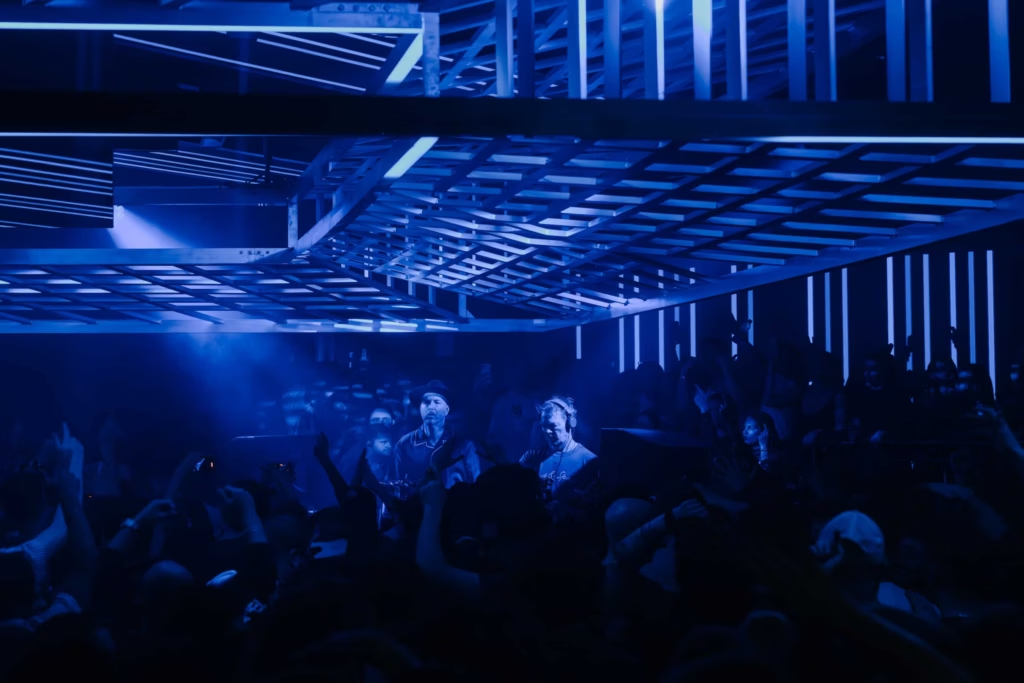
For the last 35 years, London’s Ministry of Sound (MOS) has been a catalyst for dance music. Since founder Justin Berkmann first opened its London doors in 1991, the venue has championed all walks of dance music, from kaleidoscopic house to techno-colored techno and trance-inducing drum and bass.
On Thursday, February 26, the venue re-opened its doors for an exclusive first look at a renovation five years in the making. MOS transformed its Elephant and Castle location into a networking hub of industry insiders and creatives. With drinks flowing, DJs Siân Owen, Omari Daniella Font and Chanel Carmichael took to the decks, while MOS’s Group Managing Director, Caitlin McAllister, delivered a powerful speech teasing a 35-city world tour, a birthday weekender in October and virtuously thanking partners. “[This] is just the beginning,” she noted.
The club’s refurbishment introduced a whole new energy to its prestigious room, The Box. Known for its rich history of hosting acclaimed DJs like Fatboy Slim and The Blessed Madonna, The Box has remained a pivotal part of MOS’s story in its almost 40-year history.
Inside, archival pictures covered the walls of The Box, documenting raw moments from the 1990 development stages and sharing the storied past of the venue. Within each photo, nostalgia is ever-present, evoking a yearning sensation for the community embedded within the early years of the club scene.
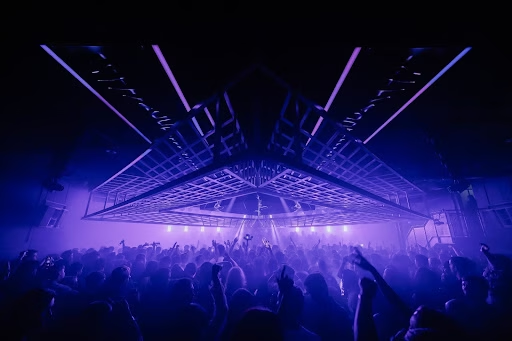
Reflecting on the venue, MOS’s club director, Matt Long, stated, “The Box has always set benchmarks, particularly around sound. This renovation allows us to reset that standard for the next generation to continue evolving the space without losing its identity.”
The club’s renovation sees a whole new transformation for this space, including a whole new audio experience, thanks to a six-point KV2 sound system, captivating the room with an immersive feel.
Over the years, London’s club scene has deteriorated drastically. In August 2025, The Standard confirmed that “one in five late-night bars and clubs have shut down since 2020.” At the time, this included prestigious venues such as Printworks, Heaven and Pryzm.
The discourse that clubbing is dead is an ongoing conversation. And there’s plenty of validity within it, since the global pandemic between 2020-2021 threatened the scene’s longevity with more widespread shutdowns. Since then, venues have fought immensely hard to stay alive, though almost six years later, we’re finally seeing signs of progress.
While iconic spaces like Manchester’s Hacienda, or South London’s The Fridge, that defined the very foundations of the club scene are no more, venues such as Fabric, XOYO and LOST have reopened their doors. Printworks is currently in talks to bounce back sometime in 2026.
If the history of these spaces taught us anything, it’s that the scene is resilient. While some of these spaces fell, others continued to adapt and fight for survival, proving that club culture has a lasting importance that refuses to lose its spark completely.
In all of this, MOS has remained steadily positioned as a place for people to live and breathe the music. In today’s world, clubbing can often feel like a corporate-operated system. Though MOS continues to return to its roots with piercing strobe lights, haunting fogs of mist that filter each room, and DJs with drops that vibrate through the floors.
There’s still a way to go to restore the club scene in London, and this isn’t something MOS can achieve on its own. That said, it’s doing its part to bring life back into a space that’s seen a sharp decline in the last decade.
Long live the club scene!