
Harsh winter months provide the perfect backdrop to consider some universal truths: the transience of connection and beauty, the cyclical nature of life, and our smallness as humans in the vast cosmos. Pem, aka Emily Perry, digs into these themes through nature and the seasons on her latest EP other ways of landing.
As an indie musician, she grew up in the ballad-heavy, folk-adjacent UK scene. She’s in good company, counting The Last Dinner Party, The New Eves, and Mary in the Junkyard as peers, having played supporting slots for all of them. Her 2024 cloud work EP single “awe” has already racked up more than a million streams. Now, the softly spoken artist prepares to embark on her first solo tour in March, a run that promises to enchant just as much as this emotionally resonant, far-reaching release.
Joining our call from Surrey Quays in London, Pem discusses the ideas behind her new EP, revealing how the rhythms of daily life inform her music. “This EP is so much about seasonality, because it was so rooted in working in the garden,” Pem tells CONE “It started in the winter and ended in the autumn. So, it was a really perfect way of watching things over time.”
Her day job as a gardener extends and feeds into her artistic purpose. She creates observational sound collages that blend field recordings with elegant, bird-like melodies.
Other ways of landing is not the first musical sequence to describe the seasons (shout out Vivaldi’s The Four Seasons). But Pem approaches natural cycles more broadly, rather than describing explicit snapshots in each song. The project also introduces more electronic manipulation and experimentation, subtly evolving from her earlier folk style while retaining the tactile analogue textures she values.
“I’ve been playing a lot more with field recordings and looping different sounds, affecting instruments. There’s more depth of sound through different pedals and manipulations that I’m using on the guitar or with my cellist,” she explains. On the EP’s themes, Pem emotes as she says, “there’s the ability to capture rawness and depth and richness in quite a light and floaty way.” Over video call her gravely feminine voice, like her singing, holds softness and strength equal to her music.
The title track opens in January 2025, winter. “You say it’s only timing, but it’s always coming back,” Pem’s soaring vocals declare over a diffused music-box-like piano loop. The repeating melody has a circular, hypnotic quality that evokes a sense of surrender to the elements—and particularly, to nature in the city.
Pem lays out, “The song title [“other ways of landing”] came because I was working in a very small patio garden last January, and I noticed an oak seedling growing through the tiniest crack in this concrete pavement. I really liked the idea of something massive as an oak tree trying to grow in the most impossible space. And how it would only get to a certain point. And then, concrete would start moving, or it would just cause this massive shift.” Pem stops to write down lyrics and inspirations on her phone. It’s easy to see the oak’s life-cycle as a metaphor for an emerging artist in the city, too—smallish for now, but persistent.
The irrepressible sides of nature appear on “m4 windy,” conjuring the image of driving on the M4 motorway in strong winds. Taking apart the sonic elements, Pem says, “[It’s] a lot of really high-pitched, distorted cello. And then some sounds of the instruments coming in. And some of the rustling [leaves field recordings] are all in that song.”
The layered sounds of analogue instruments, digital production, and raw, earthy field recordings speak to the belief that “we can’t escape [nature] or deny it.” Pem is interested in alternative ways of living, anti-capitalism, and working with life’s cycles rather than static repetitive processes. Her nonconformist ideas are of course best expressed with music that is far from cookie-cutter. Lilting riffs and Pem’s seemingly untethered vocal range tumble effortlessly in contrast with what can be the restrictive urban landscape of London. The music is romantic, but not idealist.
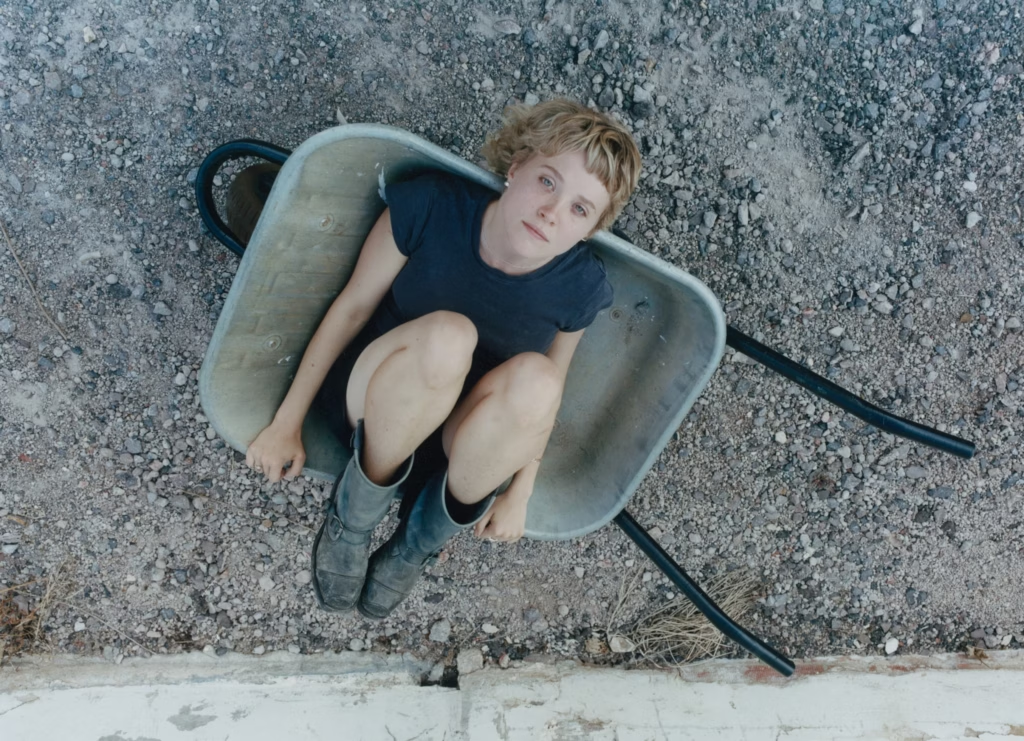
The sounds of the gardens where she works are threaded throughout the EP, creating fine textures in the songs. Pem adds, “most of [the field recordings] were from when I was gardening. Like the sound of me moving the wheelbarrow, They’re all woven in quite subtly, in some of the songs. In the newer stuff I’m working on, I want them to be a lot more obvious. But I was kind of teasing, just to see how that felt [in the EP]. Wind sounds and leaf rustles are the sounds of the wind going through trees.” She goes on to share the harsh realities of working in the cold and the sense of surrender any gardener might feel to the elements.
Cosmic imagery also shapes the EP, particularly in her music video for “to earth will you tell me when we land.” Pem reflects on this inspiration, saying she really likes “this term Syzygy.” “Sounds weird, but it’s basically this really fleeting moment in the solar system when three planetary bodies basically align in a near perfect line for a small moment of time. It’s like perfect, a straight line”, she explains. “I think that’s crazy and gorgeous. And I like the idea of relating that to people, and how you can meet people or have experiences that just feel so cosmic and powerful, and connected, but very deeply fated and quick moving. And then it just shifts.”
The fleeting nature of the music, which whisks past us while keeping time, on this relatively short EP reminds us if you blink it’s gone—like summer, spring or sometimes love.
Sonic experimentation continues on the EP, creating a bold heart-on-my-sleeve atmosphere. She describes her process: “more percussive things, like, there was an old piano sound. This piano was kind of broken, and we just kind of took it off. I was banging against the piano’s actual strings. There was a percussive element, and I was playing around with some metal, and recording the sound of this thin metal being shaken together. And the sound of my tools touching the ground with stones and stuff, that was really fun. I have 4000 voice notes on my phone.”
Despite the geographical specificity of these location-tagged recordings (her phone saves titles with a random grab of local landmarks), Pem’s listeners are international. “There’s people in Madagascar and these tiny islands and all over.” She adds warmly, “I could never want anything more than being able to make music that resonates with people. To see that resonating further than Bristol and London is great. God bless the internet in lots of ways for being able to make stuff like that more accessible. I hope that it brings up themes for people that can help them have a new way of feeling.” Evidently, her exploration of humanity and the natural world knows no borders.
Lead photo credit: Aiden Herron, courtesy of Pem