
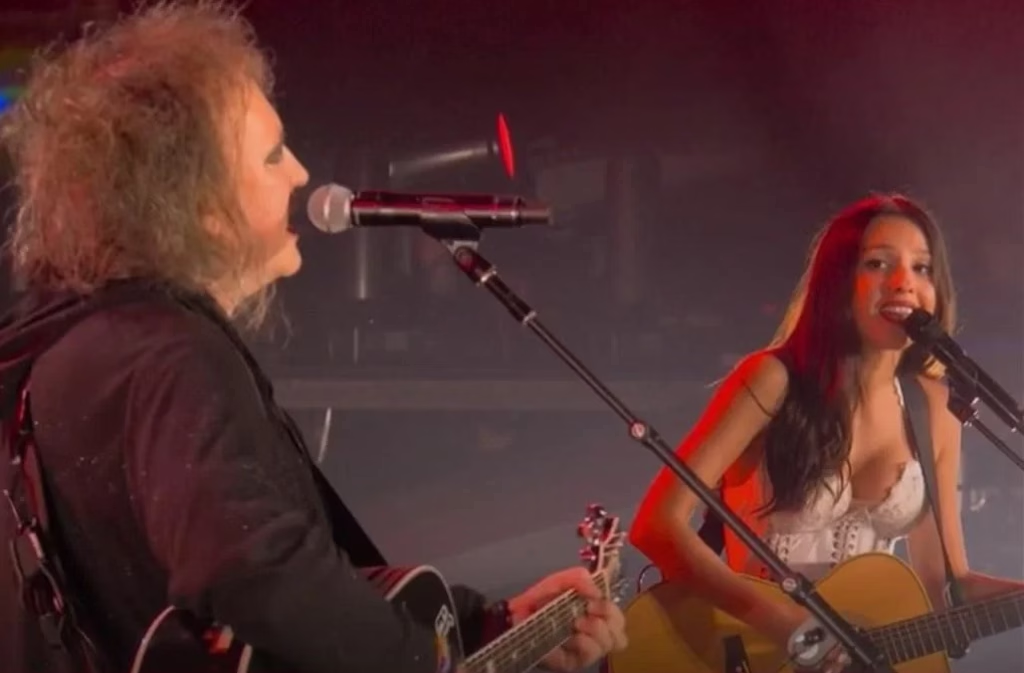
Here’s a scene. Olivia Rodrigo—22 years old, three Grammys deep, and a stadium-touring sensation—stands backstage at one of her sold-out shows. In front of her is the teenage daughter of Melissa Auf der Maur, the bassist who played on Hole’s Celebrity Skin. Rodrigo, with all the unselfconscious sincerity only real fans possess, looks at the kid and says: “Without your mother, none of this would have happened.”
No, that isn’t a PR moment. It’s apostolic succession.
It also offers the cleanest summation of where alternative rock is right now: at the center of a generational handoff that no one in the industry predicted, and no one fully knows how to explain.
The bands who defined the ’90s alternative scene—raised on 4AD records and Sub Pop seven-inches—are selling out arenas again. Not to the people who grew up on them, but their kids. Listeners born years after OK Computer came out, who never owned a CD player, or who discovered Cocteau Twins through a TikTok makeup tutorial. This isn’t nostalgia; you’d have to have lived it to call it that. What’s happening right now is something else entirely. Call it reverse inheritance.
The Deftones Didn’t Go Looking for Gen Z. Gen Z Found Them.
Let’s talk Deftones. If you want to understand this phenomenon at its most absurd and brilliant, Sacramento’s finest are the case study. Formed in 1988, they spent the better part of three decades as the smart kid’s nu-metal band. Art-metal for people who also loved shoegaze, dream pop. Now they’re currently experiencing a commercial boom that defies easy categorization.
White Pony, their third album released in 2000, has since cleared 1.75 billion streams on Spotify alone. The single “My Own Summer (Shove It)” hit 600 million individual streams. Their latest album, 2025’s Private Music,debuted at No. 5 on the Billboard 200, topping every Billboard rock chart, and moved 87,000 album-equivalent units in its first week. It was their best sales week in 30 years.
The crowds at their sold-out arena shows? Younger than you’d think. TikTok has been the engine, but frontman Chino Moreno is careful to note the band didn’t engineer it. “The funniest thing,” he told Metal Hammer in a 2025 interview, “is probably when my daughter’s friends started showing interest in our band.” The momentum took on a life of its own from there. “I think if we were on TikTok and we were just like, ‘Yo, check this out,’ and trying to market ourselves to the younger generation, it would probably come off that way. And the fact is that we don’t do that—it’s kind of what now is word of mouth, which is those platforms.”
That unsolicited quality matters enormously. Gen Z’s discovery of Deftones wasn’t packaged. No TV sync or a label campaign. It spread because kids who felt alienated, over-stimulated, and emotionally exhausted found something in Chino Moreno’s distinct blend of beauty and throttling menace that spoke directly to their strain of internet-era loneliness. Whether you find that romantic or quietly devastating, it’s accurate. And it’s working. The band currently sits at a career-high 15.8 million monthly listeners on Spotify.
Cocteau Twins Haven’t Released an Album Since 1996. 60% of Their Listeners Are Gen Z.
Meanwhile, in the dream-pop corner of this story, the numbers get stranger. Cocteau Twins are a disbanded Scottish group who haven’t released a record since 1996. Elizabeth Fraser sang in a language she basically invented from pure feeling. Yet 60% of their Spotify listeners are Gen Z. Read that again at your own pace. They are now a certified Gen Z touchstone. Heave or Las Vegas is having a moment. So is “Cherry-Coloured Funk.” The revival has e-girls burning incense and manifesting in their own words, a “shoehaze bf.”
The broader genre revival has been extraordinary. Slowdive’s 2023 album everything is alive landed at No. 9 on Spotify’s Global Top Debut Albums chart — which the platform’s own lead editor described as “unprecedented for a shoegaze album.” My Bloody Valentine ended a seven-year live hiatus in November 2025, playing their first Irish headline show since 1992 at Dublin’s 3Arena. From there, they extended their tour to Wembley Arena, Manchester’s Aviva Studios and Glasgow’s OVO Hydro, with Japan and Primavera Sound still to come. The tickets moved fast, largely to an audience who weren’t even alive in 1992.
@hannahsfall12 cherry coloured funk – cocteau twins 🪷 // since you all liked the other one smmm!! // #colourful #cherrycolouredfunk #cocteautwins #lyric #fyp
Elsewhere, Beach House’s “Space Song,” a 2015 track with roots buried deep in dream pop’s ’80s and ’90s golden era, has gone Double Platinum, arguably making it the most-streamed dream pop song in history.
What TikTok has done, essentially, is become the new John Peel. The algorithm now does what specialist radio once did: surface the strange, the textural, the uncommercial, the sonically weird. It pushed shoegaze to teenagers who’d never heard the word before. And those teenagers followed the thread backwards. They found Wisp first—an 18-year-old who recorded a shoegaze song on Apple earbuds, posted it to TikTok, and signed to Interscope before releasing a second track. Then further back through Beach House, through Slowdive, all the way to the origin point. Loveless. Cocteau Twins. The whole cathedral of sound. The genre now produces new artists, new fans, and new commercial success for the old ones simultaneously.
“1979” Is Bigger Now Than When It Was Written.
The Smashing Pumpkins have their own version of this story, and it’s stranger than most. While crisscrossing North America on their World Is A Vampire Tour with Green Day in 2024, the Pumpkins watched their demographic visibly shift. But the real signal came from an unexpected direction. “1979,” a thirty-year-old single from Mellon Collie and the Infinite Sadness, had quietly become a Gen Z anthem on TikTok.
Corgan, to his credit, didn’t pretend not to notice. He called it “kind of a Gen Z anthem” and said he believes “the song is bigger now than it was then,” but “speaks to that generation with what they’re going through.” He’s backed that instinct with action. Earlier last month, he made his first-ever appearance at Coachella—not as a headliner, but as a guest of Sombr, a 20-year-old pop-rock TikTok breakout. There he performed “1979” in the desert for a crowd who largely weren’t born when it was written. In another interview, Corgan has described the current moment as “a ’90s revival—not so much of the music, but of the spirit.
Olivia Rodrigo: Both the Product of This Revival and Its Biggest Accelerant
And then there’s Rodrigo, who is both the product and the cause of all of this. Her GUTS World Tour grossed $209.1 million from 101 shows, becoming the highest-grossing tour by an act born in the 21st century. The audiences skew young, the energy skews rock, and her setlist features guitar solos galore. Her influences—The Breeders, Hole, Babes in Toyland, Rage Against the Machine—aren’t being used as scenery. They’re structural. She helped induct The White Stripes into the Rock and Roll Hall of Fame, performing an acoustic duet of “We’re Going to Be Friends” with Feist. After the performance, she posted on Instagram: “I had a White Stripes fan account when I was 13.” Kids at her shows are going home and finding those bands.
Nothing illustrates this more vividly than what unfolded between Rodrigo and The Cure’s Robert Smith. During her headline set at Glastonbury 2025, Smith joined Rodrigo for his classics “Friday I’m In Love” and “Just Like Heaven.” She introduced him onstage as “perhaps the greatest songwriter to come out of England” and “a personal hero of mine.” The moment went viral. Pictures of the pair doing shots backstage only confirmed what it already looked like: a genuine friendship between two people separated by four decades but united by a mutual understanding of how a song is supposed to make you feel.
That understanding has apparently followed them into the studio. In March 2026, Smith told British Vogue they have “enjoyed a couple of memorable nights in the studio together.” “I can’t wait to hear what she does next,” Smith added. What that means for Rodrigo’s forthcoming album, You Seem Pretty Sad for a Girl So in Lover, nobody knows yet. But Robert Smith, who wrote Disintegration in 1989, is now making music with the biggest rock-adjacent pop star of her generation. That is reverse inheritance made literal.
None of what’s happening is nostalgia—at least not in any conventional sense. Nostalgia requires a personal past to mourn. Gen Z discovering White Pony and Siamese Dream have no history with these records. They’re not revisiting anything. They’re arriving for the first time, bringing their own context, emotional needs, and reasons for connecting with music that was made before they were born. Research consistently finds that Gen Z associates ’90s and older music with emotional honesty, vulnerability, and authenticity that feels absent from much contemporary pop. It’s a direct rebuke to the algorithmic gloss and AI sheen of the mainstream.
They don’t want to live in the ’90s. They want what the ’90s knew how to do: make music that sounds like it costs something to feel.
The new legacies aren’t legacy acts at all. They’re just finally reaching their full audience.