
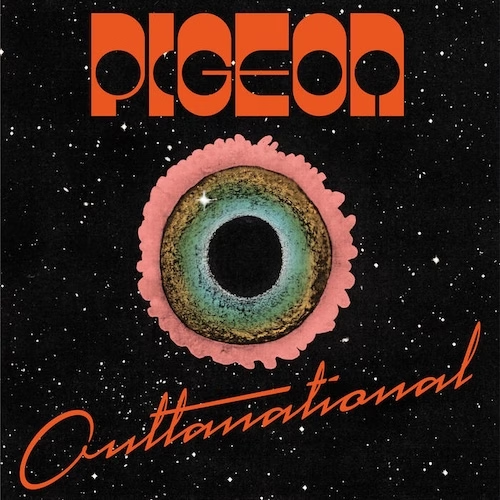
Pigeon have recorded their debut album OUTTANATIONAL in Margate of all places — the once-dying seaside town that has become, in recent years, a retreat for artists like Tracey Emin and The Libertines. The choice of location means something here. Like Margate, OUTTANATIONAL announces itself as something genuinely hard to pin down.
Across 10 tracks, there are elements of afro-disco, krautrock, punk-funk and post-punk. Opener “NRG” sets the tone immediately as lead vocalist and percussionist Falle Nioke sings of smoke magic and energy vampires over a groove that is fresh, fluid, and plain unpredictable. It’s an intriguing sonic stew that certainly grabs the attention.
Nioke is the heart of the record. Hailing from Guinea-Conakry, he is a member of the Coniagui tribe—one of the country’s smallest ethnic groups. He spent his twenties as a nomad, trekking across West Africa with a group of traveling musicians called Nimba Sacré. Together, they moved through Guinea, Sierra Leone and Ivory Coast, performing in exchange for food and shelter. That restless, borderless existence is woven into every bar of OUTTANATIONAL. Nioke’s approach is one of hybridization: traditional West African heritage pressed against contemporary UK electronic and psychedelic sounds. The result feels neither like pastiche nor novelty.
Tracks like “Black James Dean” and “Miami” are where that combination truly soars. Wiry post-punk guitars lock in Nioke’s impassioned wails, creating something that feels both organic and mechanical. The spiritual collides with the industrial clang that emerged from late-1970s depressed Britain. It’s an effective tension, and Pigeon know how to sustain it without tipping into self-consciousness.
“Mirror Test” pushes further. On the track, the band lock in and go full Berlin trilogy mode—cold and metallic. They take the atmosphere of Bowie’s late-seventies records and cut through it with the white funk elements he introduced throughout his career. It’s another reminder of what this group does best: the mechanical and the visceral, the icy and the earthy, and held in place by Nioke’s magnetic presence.
The blending of Black music and post-punk is hardly new territory, of course. Reggae was a crucial cornerstone for certain acts, with PiL being the obvious touchstone, although those influences were typically drawn from the Caribbean. What makes Pigeon’s record feel genuinely fresh is that the source is West Africa. That brings a different rhythmic language, a different spiritual weight, and a different set of ancestral stakes.
Not everything lands with equal force. The rhythm section—bass and drums—are never the problem. In fact, they’re excellent throughout. But roughly half the album meanders where it should drive. The West African highlife-inflected grooves are infectious and full of life, and it’s easy to imagine them sending a live crowd into a frenzy of dancing and movement. On record, though, confined to a 10-track indie crossover album, they lose some of their power to hold attention. The songs lack focus and direction, drifting rather than arriving anywhere.
OUTTNATIONAL is an interesting debut then, with a lot of promise and some genuinely killer singles. But it leaves you more curious about where Pigeon go from here than satisfied with where they are right now.