
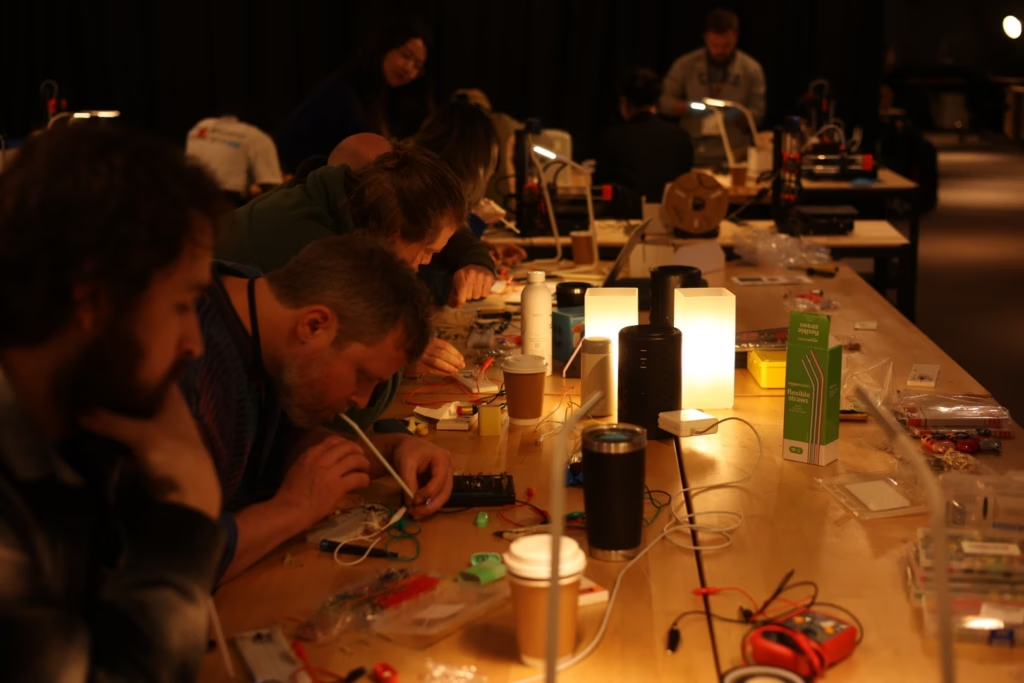
Between tech overlords tracking our every move and the rise of electronic waste as devices rapidly become redundant, we have to resist the collective urge to retreat into bunkers and don tin-foil-hats. Luckily, across the world, artists using DIY practices are reclaiming a sense of agency over the machines and systems that punctuate our lives.
We caught up with Mack Shahini, a boundary-pushing sculpture and experimental music artist based in Bristol, alongside the three minds behind the Vape Synth from Paper Bag Team: Kari Love, shuang cai, and David Rios of New York’s Paper Bag Team. Together, they helped answer the question: what does building DIY electronic instruments reveal about our relationship with technology?
Technological waste—and waste more broadly—has become a global crisis. Where it exists, some communities are able to respond to it creatively, transforming discarded materials into art, instruments, and functional technology.
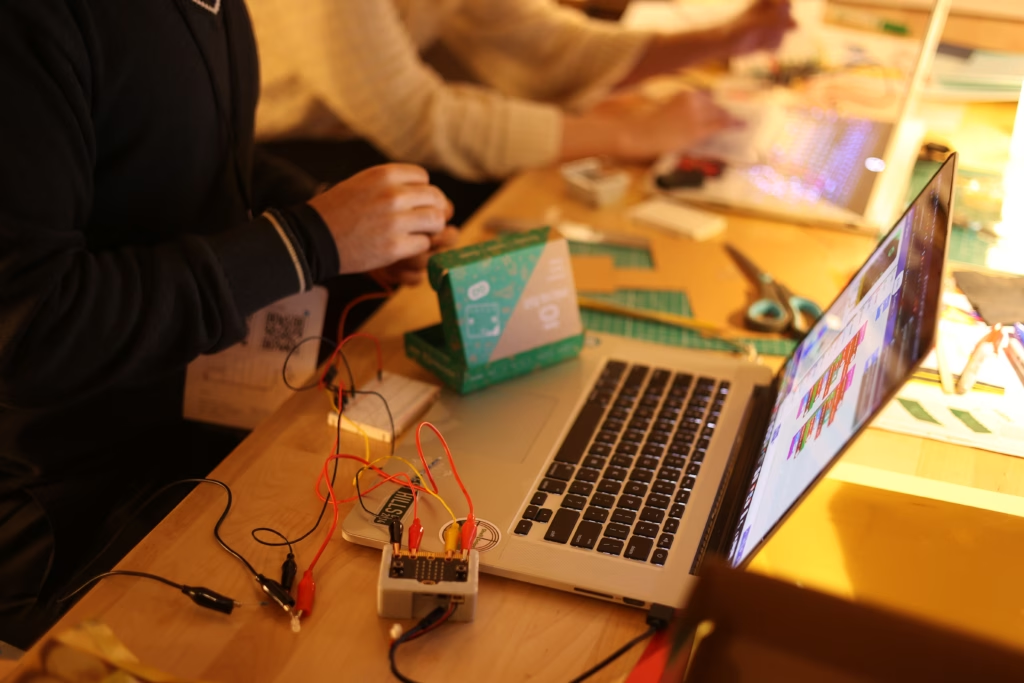
According to the European Environment Agency, “Waste electrical and electronic equipment (WEEE) is one of the fastest-growing waste streams in the world. Due to the presence of harmful additives and dangerous substances, inadequate WEEE management can pose substantial risks to both the environment and human health.” Hackers who create a working blueprint for alternative systems offer a great deal of hope.
The invention of an instrument from waste can be traced back to the 1930s and the creation of the steel pan, now an icon of Trinidadian culture. It emerged through the intelligent recycling of oil drums, triggered by poverty and the banning of earlier drums and instruments. While it wasn’t conceived as waste management, it demonstrated that recycled works can carry real skill and cultural impact. Many DIY instruments are also related to financial constraint and material limitations. Even so, the one-off object holds significant value in its uniqueness and invention.
In 1975, Kraftwerk were already touring with homemade electronic percussive instruments. Their vision of humanity creating with modern technology still resonates today. Across social media today, young people show off their cyberdecks that dodge the homogenised experience of shop-bought tech. This extends into music, where DIY has become almost synonymous with uniqueness. Music fans can lament how recording artists rely on the same “new” branded keyboard sounds, leaving tracks to blur into one another. Technology and its evolving tools will always shape the sound of a generation, but innovation is what gives music its edge.
The story that really caught my imagination about hackers comes from New York-based academics who invented Vape Synths. It sits between absurdist sound and utilitarian concept. Paper Bag Team work as thinkers first, but they are also hackers through and through. They position themselves as engineers, educators and makers rather than in music per se.
David Rios explains more about their process, which involves modifying an old elf bar to let someone play it like an electronic tooter. “The current vape instrument is a single oscillator that uses a 555 timer in a stable mode. It’s based on a circuit from one of Forrest Mims’ Engineer’s Mini Notebook series, Timer Op Amp and Optoelectronic Circuits and Projects. In the book the circuit is labelled ‘Toy Organ.’ In terms of sound, music, and circuitry, the Vape Synth is most similar to a number of toys, alarms, and other low-power electronic sound devices.”
Rios works within the parameters of the vape’s existing technology—the pressure sensor in the mouthpiece, the battery, related components—to imagine its new function. There is a mutual give and take, but the squeaky sound is still a “Toy Organ.” This humor softens the reality of the mounting electronic waste that this invention faces.
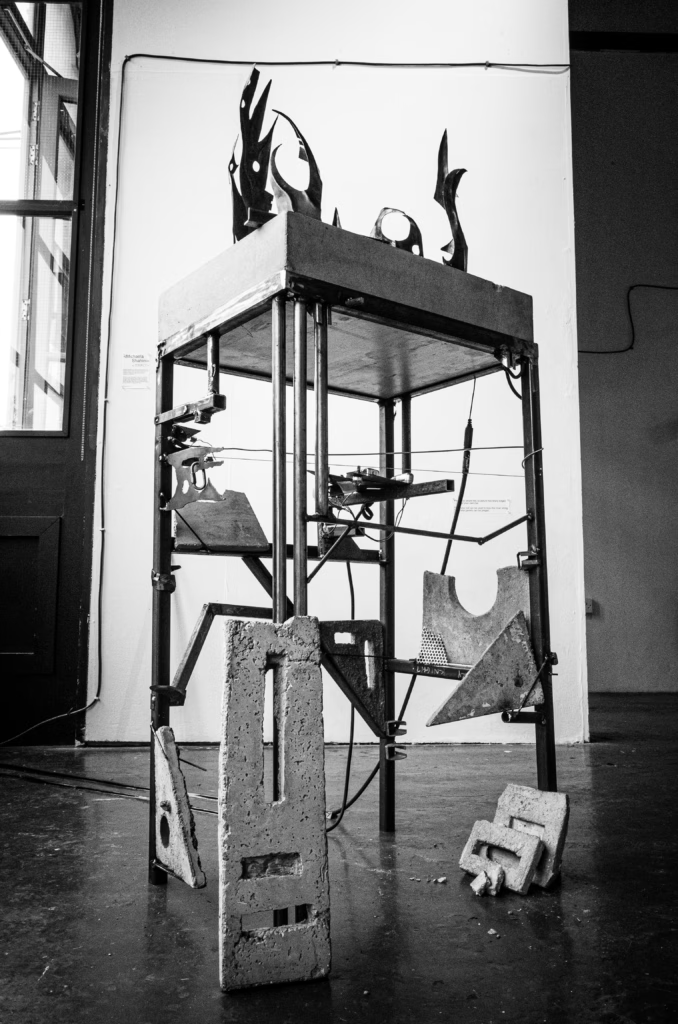
Play, and the idea of a toy in modern DIY instrument making, also appears in CONE’s conversation with artist Mack Shahini. Shahini is hesitant to call themselves a musician, even though they perform live. “Personally, I find sound secondary to the art of an object. I come from a Fine Art background, so it’s a very different lens compared to, say, a producer. I feel much more like a toddler waving around a maraca — albeit a very sharp, spiky metal one.”
Both electronic instrument outcomes, when played alone, are harsh and noisy. There’s something thrilling about these sounds, but they also resemble a warning drone or an alarm that jogs you into action.
Conceptually, Mack is decisive. “Upcycling gives people a sense of autonomy over the technology we’re using,” Mack says. Much like the cyberdeck makers, their instrument-sculptures exert a new order. Mack continues, “I think it’s a way for us to show resistance to this capitalist-tech-consumption-era we’ve all become so used to. It’s a rejection of the ‘un-usable,’ subverting this idea that our devices are sealed objects we don’t have control over. That capitalism owns technology and technology owns us.” It’s a hacker mindset, to rebel and resist in this way—to engage directly with electronics, understand circuit boards, rather than letting them be unknowable and therefore more powerful.
Mounting throwaway culture is a shared concern between Mack Shahini and the makers of Vape Synth. Shuang cai explains, “The Vape Synth in its first form is a comment on the absurdity of disposable technology and an invitation to join us in reimagining our relationship with e-waste. The MIDI version is about the opportunity to go from novelty to usefulness in the same space.”
As of May 2026, there have been no recorded live performances with the current Vape Synth, largely due to the difficulty of building your own. The team is currently working on a MIDI version that should be more usable. It may take a harmonica or accordion-like approach, or it may follow a “digital native” sound logic that allows the synth to trigger 12 notes of the chromatic scale as they exclusively explained.
The Paper Bag Team frames the project as DIY and open-source. They want to “inspect, modify, redistribute, and collectively reinterpret systems that are [usually] inaccessible or invisible”. This approach is a quieter, less explicit call to action, but it underscores the need for new ways of engaging with electrical waste.
The rebel hacker ethos is outlined in Mack’s thoughts on upcycling. “Upcycling is an act of reclamation and intervention,” they argue. “There’s a great book called Cyberfeminism Index which discusses this in more detail.”
Like an inventor, the artist often has to re-solder soundboards minutes before performing. At times, they even hold wires together mid-performance. The result is a sense of danger and freedom — “the element of the unknown–improvising with the object and the crowd.” It’s what felt missing in the DIY electronic artist Look Mum No Computer’s Eurovision 2026 staging, that unpredictability of a homemade machine.
The willingness to try, continue, and perform through improvisation is what makes Mack’s work feel forward-thinking. Perfection is boring, after all. The Vape Synth radically reimagines how we think about and value the objects around us. Farce, play, investigation, knowledge all weld together when a hacker’s output succeeds: outsiders commenting on modern issues. The real energy ultimately lies in reclaiming technology and reshaping how it serves us.