
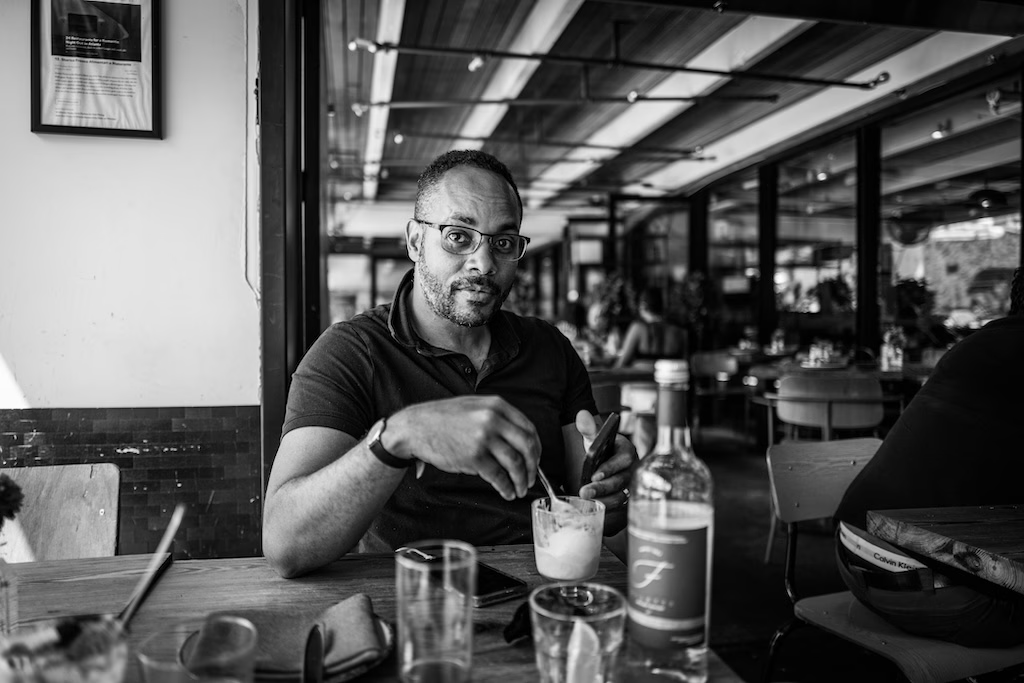
For years, Andy Mundy-Castle has planted himself at the center of socially conscious filmmaking. Whether 2020’s White Nanny, Black Child or the 2025 TV show White Man Walking, his work reflects his activism through projects that challenge social injustices.
Shoot the People, Castles’ latest documentary, is no different. It tells the story of Misan Harriman, the famed photographer whose rich editorial style made him the first Black photographer to shoot a Vogue cover. But perhaps, more importantly, Harriman has spent the last decade documenting political protests through powerful visual storytelling.
Now, 20 years into his career, with 11 films and a BAFTA to his name, it’s hard to imagine Castle before the fame, or where his inspiration first began. “To understand that I have to take you back to being a 15-year-old in South London, in a broken home, trying to navigate the world around me,” he tells CONE.
“I found true inspiration in documentaries,” he continues. “I was watching films from filmmakers [like] Ishmahil Blagrove and Sorious Samura, who was documenting Civil Wars in West Africa at the time and doing some great work on the continent. I also really enjoyed the work of John Akomfrah, who was blending style and political messaging. Those are just a few names that inspired me, but they were the genesis of me thinking of filmmaking as a tool for healing, [or] for resistance. As a tool to shine a light on social injustice.”
“We went on a journey together to tell a story of resistance.”
Shoot the People documents several years of political and cultural activism. But it wasn’t until the death of George Floyd in 2020 that Castle felt compelled to explore the cultural shift in how protests became a heightened act of rebellion.
“I think we were all looking for answers. What many people from the African diaspora were experiencing over decades prior, [was an] injustice against our bodies, our livelihoods, our being,” he says.
As such, Shoot the People became a visual documentation of a turbulent time, capturing the grief felt by thousands of people around the world. It amplified the prejudice and discrimination embedded within the system without needing to overstate its message. The images alone spoke for themselves.
“One of the voices within our community that was very loud was Misan Harriman, and I took note of that alongside a lot of other people,” says Castle. “I heard that he was in the process of documenting [a] story around his journey. We had a mutual friend who’d put us together, and that became the beginning of a working relationship that led to what you see now. We went on a journey together to tell a story of resistance, a story of hope. [We wanted] to try and bring some truth to power, through his work and his life.”
Throughout the film, Castle documents a series of protests that have occurred in the last seven years. From the Black Lives Matter outrage to the Free Palestine marches, which are still in motion today.
As an acclaimed producer and director, it’s hard to imagine Castle ever having moments of doubt. Yet he understands that getting your work in front of an audience as an indie filmmaker isn’t easy, whether that means hearing a ‘yes’ from an agent or securing funding for a project. “If you’re emerging, it’s hard to do that because where would you go and find a million people to love what you do?” Asks Castle.
Finding an audience for your story, whether you’re starting out or are an established filmmaker, is particularly difficult right now. Telling stories of activism, empowerment, and social justice comes with added challenges in today’s climate, where supporting positive movements or advocating for equality can get you locked up in a prison cell.
Despite the turbulence, the director wants emerging filmmakers to remember one thing: “Don’t censor yourself,” he continues enthusiastically, “Don’t ever think about what the person outside of your mind is thinking about your idea. Always push for the thing that makes you feel slightly uncomfortable, or the reason as to why you chose to be curious about that thing.”
“Stretch your imagination as far as you can, because there’s going to be enough people out there who will censor you.”
He expands on the importance of protecting that creative instinct, especially when others may try to limit it. “Stretch your imagination as far as you can, because there’s going to be enough people out there who will censor you,” he says. “Obviously, that should not come at the destruction of others, or with hate-filled messages, but, if it’s something that’s deep inside of you that you want to express, it’s so important not to censor yourself. Have faith in what you’re producing.”
There’s no denying that Shoot the People is an attention-grabbing title, and the footage keeps you on your toes. At times, it’s a hard watch, while other moments are incredibly enlightening, gracious and insightful.
For Castle, the hope is that those who watch the movie leave with a deeper understanding of its message. “Regardless of how you feel about the subject or protest, I hope that people leave with a sense of ‘I got to think a bit harder about my neighbor’,” he tells me. “Or, [they think], ‘I’ve got to think a bit harder about how I speak up for somebody when they’re not in the same room as me, but they’re being spoken down on.’ Whether or not that happens, hey. But I hope it provokes thought in that way. And I hope it agitates change in some way.”
Lead image photo credit: Alex Rowley