
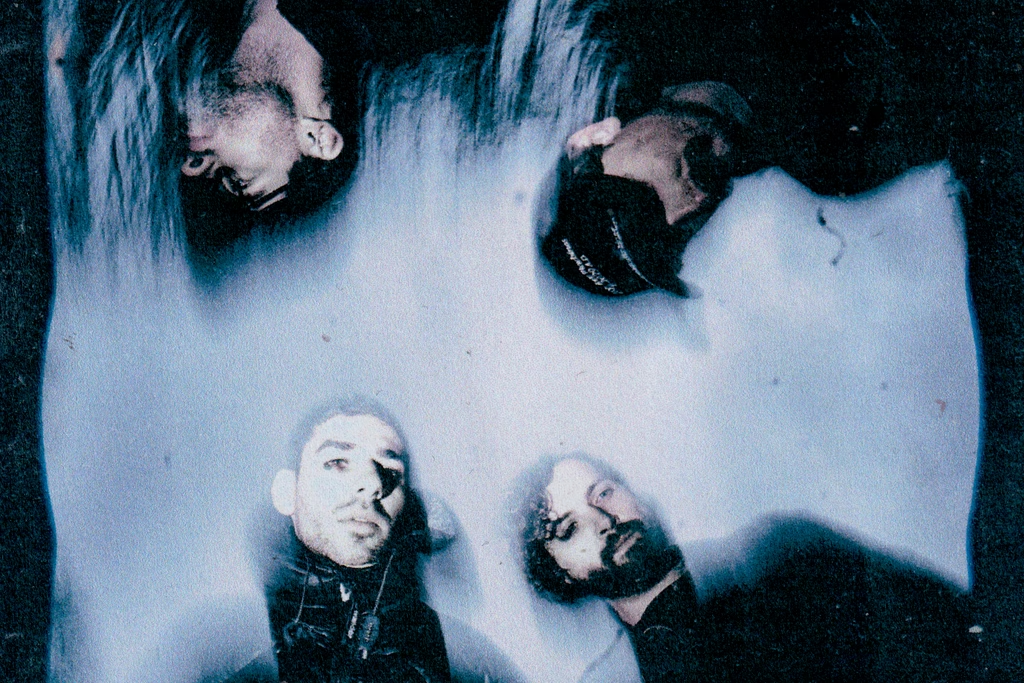
You can confront yourself at the edge of destruction. In the club, when the music is the only thing that feels real, disorientation can either make you lose yourself or reveal who you are.
Scaler captures it perfectly: “You lose yourself initially. And then, if you push through that wall, you find yourself on the other side—hopefully, unless you’re too battered.”
The intensity of a heavy club night mirrors the power of this EBM band, especially live. On their European tour, two members of the four-piece—Alex Hill (electronics) and Nick Berthoud (guitar)—opened up to CONE over Zoom. We caught them as they set up for Manchester.
Forged in Bristol’s burgeoning music scene, Scaler draws their sound from the city’s fruitful culture of events and sonic experimentation. Their driving, trance-inducing rhythms and mind-bending visuals have carried them from The Bristol Germ in 2017 to the 2019 Simple Things Festival and finally, to Glastonbury in 2023. Their current tour will conclude at Berlin’s iconic Berghain on December 8.
For Hill and his bandmates, Bristol presented “a new palette of sounds that reframed a lot of the music that we’ve loved our whole lives into a more contemporary context.” The city’s sonic identity seeps into Scaler’s towering beats, cavernous electronics, and sharp punk riffs, with Massive Attack and Portishead looming large as clear influences.
“You lose yourself initially. And then, if you push through that wall, you find yourself on the other side”
Since 2017, Scaler has made the stage their home, gigging for two years before releasing their first track. They channel the chaos of modern life into dense, thought-provoking soundscapes that push audiences toward a spirited, almost out-of-body release. Their oft-cited SWX/Electronic Bristol set at Simple Things, two years after their debut Chamber, fused industrial techno with punk rock, punctuated by bursts of noise. That success proved outsider music can have mass appeal.
Each member brings their own flavor and influences to the mix. “It’s all around bass music and stuff. But bands like Massive Attack, I’ve been listening to since I was born. Really, my parents always enjoyed it,” Hill shares. “Hearing those themes and ideas recontextualized through contemporary Bristol music and club music makes those formats exciting again. That hopefully is present in our music as well.”
Scaler remains singular. Tracks such as “quiet when it speaks” and “Ravine,” which bookend their 2025 album Endlessly, showcase the familiar caustic, metallic textures fans associate with the experimental band. “Mirage” and “Sinking In” hint at Bristol’s trip-hop scene without being derivative. Every track carries the dark, disturbed energy of the city’s underground culture.
When it comes to escapist live shows that shape the band, Berthoud explains, “There’s definitely singular events, promoters, or labels that we can pinpoint for each member of the band for having that moment of escapism, or that moment where everything fell into place and all these elements linked together. For me, it was Howling Owl Records’ New Year/New Noise at the Arnolfini (2017), where Gilla Band—then Girl Band—played with Lice. It’s moments like that where everything we’re doing now was born.”
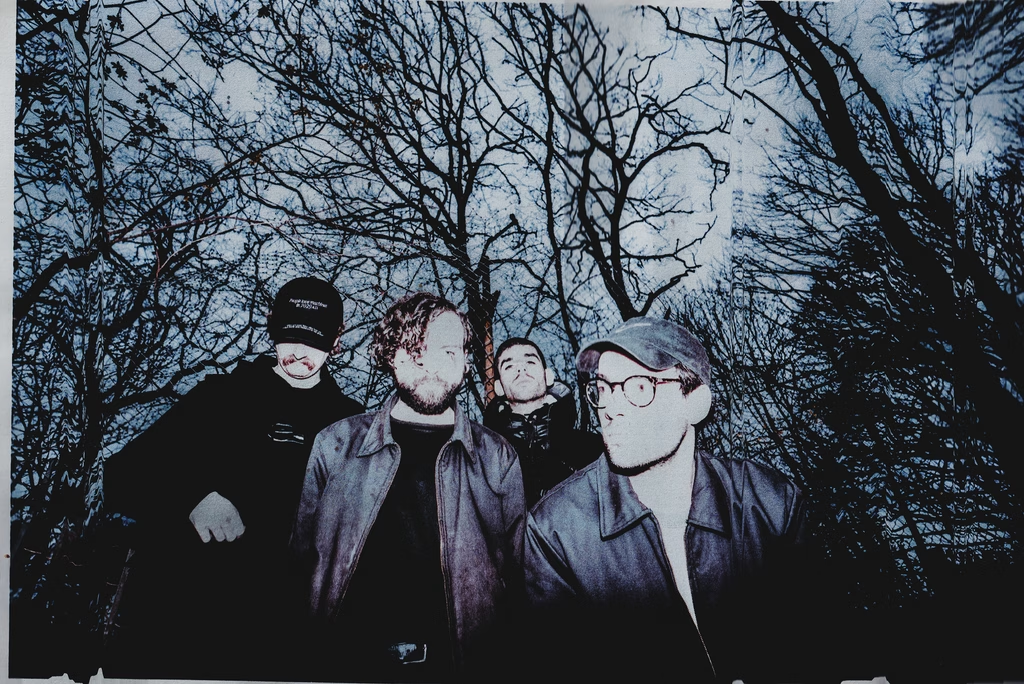
Fully immersed in the live scene, the band embraces what the city has to offer. This openness fuels songs designed for euphoric oblivion, creating a sound that thrives on shared release and immersive connection.
Scaler’s music unleashes an experimental, industrial cry—harsh at times, but ultimately cathartic. Hill remembers this sense of release was central from the start. “I think [catharsis] was, from the very beginning, one of the main ideas behind mixing these sounds together. Obviously, dance music is very intertwined with escapism and losing yourself in clubs and those environments, maybe less so than heavy guitar music. But we’ve always felt those two things go hand in hand.”
He goes deeper, drawing a direct connection to the intensity of heavier music: “The pure power and bulldozer energy that you can experience with heavy music—that more industrial extreme metal side of things—is an escapist feeling. When you transcend, when it’s just so heavy. I’m not saying we achieve anything near that, but it makes sense to us that the two worlds belong together. A hundred percent, that was a big appeal for us straight from the start.”
Driving, desolate, and apocalyptic, the band has a cult following that will likely grow now that Endlessly features vocals and pop elements. This is totally unlike their previous album, which included only two vocal features.
The record opens with alien-landing sonics before gradually moving into resonant vocals. The band sets out with the single “quiet when it speaks,” which Hill notes, “presented itself as an introduction.” He adds, “It feels like it’s its own landscape, without necessarily having just any discernible, identifiable features or landmarks. This is the world you’re in now, and hopefully the tunes feel like they exist in that world.”
“[Catharsis] was, from the very beginning, one of the main ideas behind mixing these sounds together.”
As the album progresses, the instrumental landscape continues to expand. On the track “Salt,” the addition of Akiko [Haruna]’s vocals transforms the song. “Before Akiko [Haruna] put their vocals on ‘Salt,’ [it] continued that landscape quite nicely. She made it into its own landmark, which is where the alternative pop thing came from. Before we had vocals on it, it was like an industrial drill tune. They kind of belong in the same world,” reflects Hill.
Each element asserts itself, subtly shaping the tracks in its own way. Berthoud emphasizes the melody over lyrical meaning, stating “All the vocalists brought interesting, melodic ideas that we would’ve never included ourselves. Akiko’s part almost goes Evanescence-esque at times, which we would have never reached for from our palette. My favorite thing from working with all these vocalists is seeing how it’s adapted.” This open-hearted collaboration strengthens the sound, with each artist’s contribution carving its own space while deepening the album’s cohesive, immersive world.
Drones—long, sustained tones with roots in ancient musical traditions—are “ever-present” in Scaler, according to Hill. On “Sinking In,” featuring Shadow Stevie, these ritualistic drones combine with vocals that verge on chant, creating moments that channel spinning out.
Hill traces the role of drones in their music: “You can trace that line from the first civilizations through everything. It [drones] entered pop music in the ’60s, and it’s a massive part of what we do—whether it’s guitar, feedback, samples, or drones. Every song we make probably has a drone of some kind happening.”
He elaborates on how drones shape both the band’s sound and their live performances: “[Drone is] a tool, part of our language, especially in the live context, when you’ve got loud guitars playing. It’s quite psychedelic. There’s sunn O))), like I mentioned, and Swans, that do it incredibly well. And you reach that point again that you kind of break through. Transcendental, hopefully.”
Trippy, immersive, and all-encompassing, Scaler hurls listeners into another world—a disorienting, transcendent space crafted for shared experience and collective communion.