
Is everything a little too easy? Streaming apps and the iPhone were initially built as tools to serve us, but have quietly turned users into the product: checked out and profitable. But as design elements that invite choice shrink or disappear, so does active participation. Even Reels don’t require us to scroll anymore. And with that ease, the act of listening changes entirely.
It wasn’t always this way. Leafing through CDs, vinyl, or even an old iPod’s alphabetical artist list and tactile scrolling system used to encourage participation. Now, opening Spotify often means getting stuck on a treadmill of the same songs or albums you just heard, even on playlists that are supposedly on shuffle. It’s time to escape the spoon-fed taste matrix.
The debate between digital and physical formats is longstanding, with each medium somewhat shaping listeners into active or passive participants. Formats are interlinked: vinyl often carries traces of digital recordings, and digital environments remain attached to material music culture.
Still, there’s no denying: streaming is practical. That’s likely why Spotify accounts for 751 million listeners worldwide. It is more affordable than vinyl, even as this physical medium makes a comeback.
With Spotify’s rise, a certain level of choice slips away like sand through a smashed hourglass. Liz Pelly’s book Mood Machine: The Cost of the Perfect Playlist exposes the issue of Spotify’s “ghost artists.” She writes, “ghost artists are linked to certain production companies,” and these companies often produce stock music for advertising.
In 2022, Swedish daily newspaper Dagens Nyheter revealed that around 20 songwriters were behind the work of more than 500 artists, with thousands of tracks streamed millions of times on Spotify. Artist descriptions were even falsified on the streaming platform to make invented performers appear real. The BBC has also reported on AI fake artists on the platform. This breach of trust bends authorship and reality to Orwellian effect.
Spotify denies involvement in ghost artists, yet the company does push this stock music onto popular playlists, presumably to avoid paying real artists for their work. Apple Music and Amazon Music are believed to be using ghost artists too.
Passive listening combined with indifference to the musicians allows stock music invented by advertising companies to go under the radar and rack up digital streams. A lack of cross-referencing from a listener’s standpoint contributes to the problem, although we should also expect distributors to do better. As Pelly notes, a playlist aptly titled “Piano in the Background” perfectly illustrates passive listening in a digital setting.
At least vinyl credits human artists, even if the listings are fallible or incomplete. AI bots haven’t started pressing generic records extensively, but forums associated with Suno AI report users doing so. Physical albums and mixtapes on vinyl are not fully safeguarded either. There’s also the case of the AI Beatles’ 2023 track “Now and Then,” available on vinyl, which is another debate in itself.
Record players are not accessible to everyone. It’s a privilege to own, and many models require dexterity that can make them difficult to use with a physical disability. But the record player’s merit compared with Spotify is a different sort of mechanical design neutrality. It leaves the thinking to the humans operating it.
From a discovery perspective, a record player does not tell you what to choose. Meanwhile, Spotify uses predictive search mechanisms that assume you want to listen to the same artist or song repeatedly, rather than benefit from the breadth of the platform. At the level of tool design, this encourages unthinking decision-making over discovery. Where a record player awaits input, Spotify’s helping hand quietly forces listening into a box.
Physical media removes the stabilizers of tech that can stunt mental function, as MIT’s study on AI use and the brain suggests. When reviewing and selecting music through a more physical, involved process, listeners are likely to learn and retain more. Tactile engagement encourages a more active listening experience. Modern philosophy, including Cixous’ feminist Medusa’s Laugh and Foucault, places human knowledge in the physical body and writes the body as a site of power. This moves beyond Descartes’ mind-body dualism, framing the human body as a tool for creating and enacting new realities and ideas.
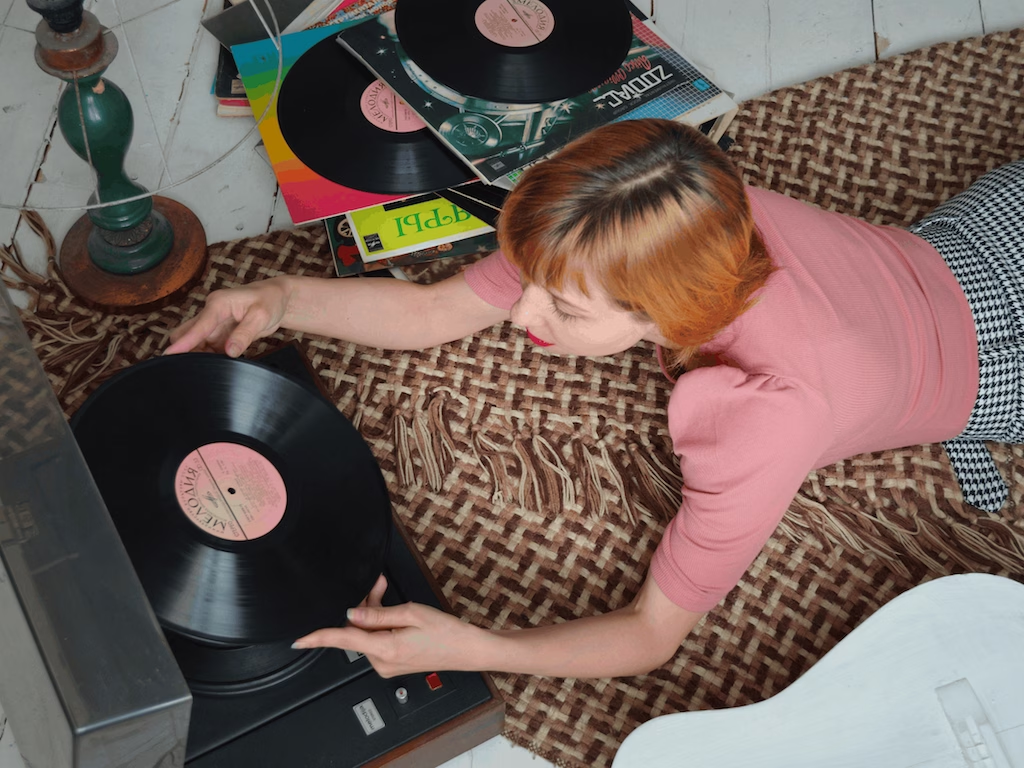
At a turn table, you gently hold your favorite record, position the needle, and read the lyrics. The process helps keep you present, actively engaging with music you care about. Vinyl also limits distraction: record players are generally screenless, and using one calls for a wider range of physical movement.
A 2022 psychology study entitled, “Vinyl as Fine Wine: The Role of Expectation on the Perception of Music Format,” found that participants enjoyed music more simply based on being told they were listening to vinyl. They concluded that “if a person believes that vinyl sounds better, the listening experience will be better, regardless of sound quality.” The same expectation around vinyl as dedicated listening time could also color how we respond to records.
Musical short-changing by fake artists or passivity-inducing mechanisms like bot-curated playlists is not the consumer’s fault, nor something that can be resolved simply by spending more. In Marx’s Theory of Alienation, István Mészáros wrote “Ethical consumerism can cement people’s identities as passive consumers rather than active citizens. Life is about more than just retail and we must not allow all major functions of society to be subordinated to the task of shopping.” So, it’s more than just shopping that makes for active listening.
Considering vinyl as the only way to be a more active listener oversimplifies reality. We’re not at the point of operating physical defiance through vinyl like the so-called “bones” or “ribs” in the USSR, where banned music was pressed on discarded x-rays. But physical media does hold history and data. Expectation and the physical mechanics of interacting with music shape how we engage with music.
Assigning vinyl as active and digital as passive is a hall of mirrors and contradictions. You can listen mindlessly to a record just as easily as to a Spotify stock playlist. Some tools nonetheless are designed to push us toward passivity. Ultimately, the listener decides how to engage. Conscious attention and reflection makes listening particularly meaningful.