
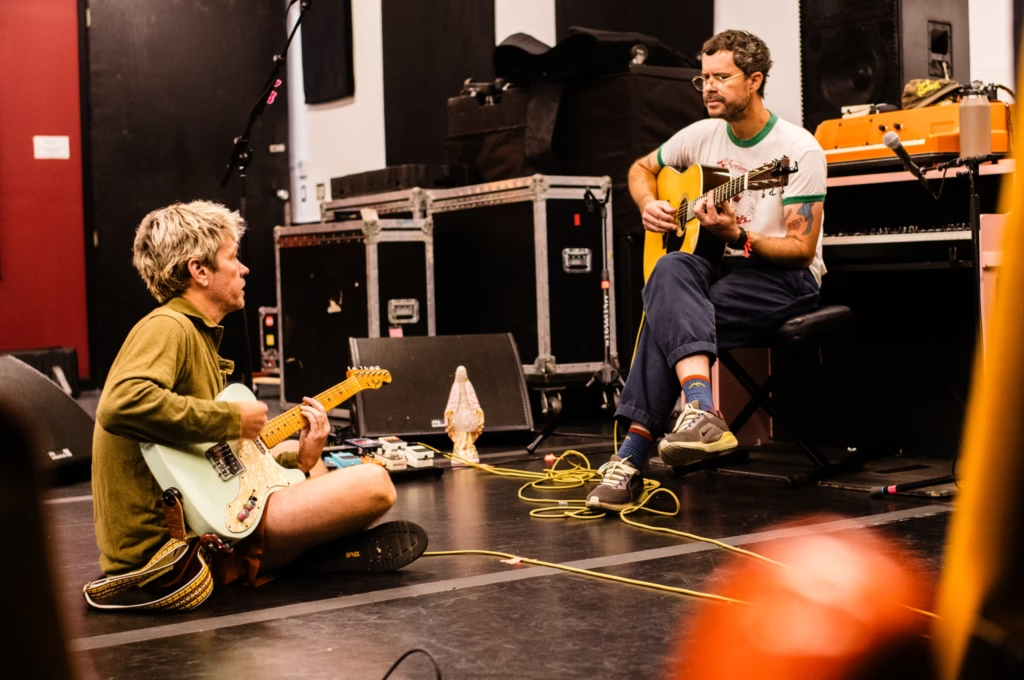
They never dented the Billboard charts or crossed into mainstream stardom, but those who encountered The Format during their initial 2000s run were deeply enamored. The creative partnership between singer Nate Ruess and instrumentalist Sam Means explored a maximalist take on indie-pop, fearlessly blending big, sing-along hooks and bright guitars with subtly devastating lyricism. The approach paid off across their two studio albums, 2003’s Interventions + Lullabies and 2006’s Dog Problems. The band wouldn’t survive the decade, however. The pair went their separate ways in 2008, and Ruess achieved that elusive crossover success with his next band: the alternative pop trio known as fun., who broke through with the multi-platinum anthems “We Are Young” and “Some Nights.”
After over a decade apart, Ruess and Means found their way back to one another. They decided the year ahead would be their year to get back out on the road. Unfortunately, the year they chose was 2020. After 18 months of postponements, the pair pulled the plug on their reunion. And that, seemingly, was that. Behind the scenes, the pandemic downtime inspired Ruess to write his first new music in years, including songs written on guitar, an instrument hadn’t played before the Covid-19 pandemic.
“Nate invited me to his house to hear some stuff he’d written, and it was so good,” Means tells CONE on Zoom from his Phoenix home. “I asked, ‘What are you doing with this? You gonna make an album?’ He said no, but I told him that was dumb. About six months later, he hit me up and said ‘actually, maybe I do wanna make an album – and I wanna call it Boycott Heaven’.”
They began recording demos, and Ruess soon recruited producer Brendan O’Brien—whose CV includes albums by Bruce Springsteen, AC/DC and Aerosmith (“They’d gone golfing together, believe it or not,” Means laughs)—to join. At that point, they still hadn’t put a name to what they were creating. Reflecting on it now, Means says, they were “only about halfway through” the recording process that the project started to feel like a Format album.
“The spirit of it felt like a Format album, and the way we were working on it felt very similar,” he says. “A lot of the tones and themes started feeling like this was an extension of our past, picking up where we left off in a lot of ways. None of this was planned, but once it started happening, it was really exciting.”
With Boycott Heaven still their best-kept secret, The Format announced three live shows for September 2025. Kicking off with a hometown shindig at Veterans Memorial Coliseum’s 14,000-capacity space, it became their biggest headlining show ever. Means explains that the booking was a deliberate overshot of what they perceived their popularity to be.
“In 2020, we were going to play this much smaller venue,” he explains. “We added two more shows there, and they all sold out. This time, we picked this really big place and booked it during the Arizona State Fair. [We figured] we’ll play this huge place that’ll never sell out, so we won’t have to worry about people not being able to go. Maybe families can come after they’ve gone on some rides.”
Imagine the band’s surprise, then, when they promptly sold the arena out. “We never expected it,” says Means incredulously. “That was a magical night. There was an energy there that we’ve never really experienced before. People did bring their families, too. After 20 years, a lot of our fans got married and had kids, and they all became fans too.”
During the Arizona State Fair show, the band snuck a brand-new song into their setlist: “Holy Roller,” which went on to serve as Boycott Heaven‘s lead single. “Everyone’s looking around confused,” Means recalls. “They’re like, ‘is this an old song I never heard? A B-side or something?’ About a week later, we did Jimmy Fallon and announced it to the world.”
“If the path towards heaven is stepping on your neighbor’s neck, is it really worth it? When someone boycotts something, it’s usually not because the thing is inherently bad. It’s because it needs to be better.”
Though recorded at a completely different stage in their lives, Boycott Heaven fits comfortably into The Format canon. Ruess’ distinct vocals and newfound guitar skills drive the more rock-oriented numbers, while Means’ multifaceted playing gives each song its own dynamics and depth. They’re the same best friends who shot for the moon 20 years ago, but now operating under far less pressure. Means says that neither he nor Ruess placed much weight on the gap between Format records. “I just wanted to help finish these songs in any way I could. And Nate was very eager to have someone help finish them,” he adds.
For Means, pressure came in other ways. “When we went in to actually start recording, I felt a little terrified,” he reveals. “I thought of myself as the least experienced person there, working with a legendary producer like Brendan. And with Matt Chamberlain, who’s just a phenomenal drummer. Even Nate’s been very accomplished as a singer-songwriter. I was definitely the one who’d had the most downtime. As soon as I got in there, though, it felt right, like this was where I was supposed to be.”
Means points to the album’s fourth single, the tender ballad “Right Where I Belong,” as being serendipitous in nature. True to its name, Means knew The Format’s reunion was the right call during its creation.
“That one really hits home a lot,” he says. “It’s a song that shares a lot of feelings—the love for my family and friends and the experiences that we share together. In that moment, recording that song truly felt like this was where Nate and I should be. All this time had gone by, and it felt strange to not be together. Ultimately, though, where we are today feels like the right time. The album sort of became a testament to that, and I think that’s really going to come across. People are going to feel it.”
From the hypnotic, autoTuned “No Gold at the Top” to the stark piano balladry of “Back to Life,” Boycott Heaven is already a frontrunner for 2026’s best indie rock album. It’s an evocative, emotive and entirely endearing effort that has not only rekindled one of the 2000s’ most underrated musical pairings, but also given it a new lease on life.
There’s one last mystery: Why Boycott Heaven? After all, Ruess called Means with the title in mind long before the title track had come to fruition. Means, of course, can’t speak on behalf of his cohort, and never has: “I’ve never really asked Nate about that stuff,” he says. “That’s very intentional. I like having my own interpretations of his incredible lyrics.”
When Means is asked what the phrase “boycott heaven” means to him, he stops for a beat, looking out his window as the sun starts to set over Phoenix. He exhales and says, “We’re going through life looking for a reward, whether that’s happiness, or peace.” He pauses again before eventually saying, “Our ‘heaven. ’”
Means continues: “It seems, especially now more than ever, that people are getting trampled along the way. If the path towards heaven is stepping on your neighbor’s neck, is it really worth it? When someone boycotts something, it’s usually not because the thing is inherently bad. It’s because it needs to be better. That’s a really important message: Whatever the reward is at the end of this life, is what you’re doing something you’re willing to keep doing for it, or is a boycott in order?”
Photo credit: Good Harbor