
There’s something quietly disarming about Concave, the debut album from Chicago-based singer-songwriter Delaney Bailey.
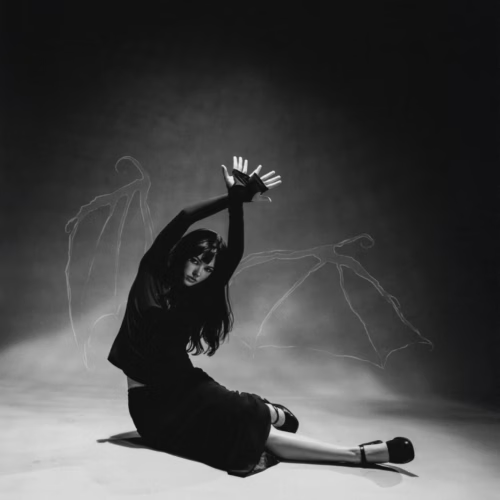
It doesn’t arrive making a big, declarative statement. Instead, it slips in gently, more like an invitation than announcement. The mood sets immediately through the cover art: Bailey in stark black and white, bat wings faintly etched behind her. Glamorous, sure, but also faintly ghostly, hinting at the album’s delicate tension between seduction and sorrow.
Bailey’s voice is the record’s steady anchor. It drifts between soothing and smoky, sometimes shifting within the same song, as if she’s whispering something private before pulling away. It’s a voice built on restraint, and Concave wields that restraint wisely. The production keeps things spacious and atmospheric, favoring slow emotional washes over obvious crescendos.
Bailey knows exactly how to land a line without overplaying it. The single “Far Away” is a masterclass in that art. One couplet in particular lingers: “From my view now, I am 24 and grown / God looks like a stranger in a bar who reminds me of home,” she sings. It’s intimate, reflective, and quietly devastating, delivered without a trace of melodrama. The song itself is phenomenal and was a highlight of 2025. It’s also the closest Concave gets to anything resembling “jaunty”—and that’s generous. The melody pushes forward while the emotional weight remains firmly in place, giving Bailey her most accessible moment without sacrificing the album’s introspective core.
The tone gets darker on “Lion,” which leans into a shadowy darkwave palette. Haunting electronics and synthetic drums give it a brooding edge, but just as the track starts to sink its teeth in, it fades out, perhaps too quickly. Still, that fleeting quality feels intentional. These songs play like emotional snapshots rather than fully unpacked confessions.
“Wither” is another memorable number, echoing Punisher-era Phoebe Bridgers, though Bailey’s delivery feels even more tender. Pastoral, even. Soft acoustic textures dominate production, while bruising bass notes occasionally drift in to add grit. “Retainer” follows a similar trajectory. It slowly builds toward a powerful, emotive near-explosion, only to bow out sooner than expected, leaving a lingering sense of breathless tension.
The album subtly shifts the sonic palette with touches of autotune on “Wake Up.” This isn’t a party track, though. It’s the lonely aftermath of leaving a gathering alone, waking up alone, and sitting with the crushing defeat of it all. Lyrically, it flirts with classic Smiths-era territory by exploring self-aware loneliness, romantic disappointment, and wry isolation. These elements make it one of the album’s understated moments.
Taken as a whole, Concave is equally seductive and heartbreaking. The warmth of Bailey’s voice stops it from sinking too far into gloom, and the production is striking, especially for a debut.
My one recurring gripe? Nearly half the tracks barely pass the three-minute mark. Call me an old goth at heart, but I want to wander around in these spooky songs—to linger with them, let them settle, and feel their weight fully.
That feeling is best realized on the title track, which closes out the album. It’s the longest and most immersive song on the album. Bailey gives the arrangement space to breathe, letting the mood swell and recede as she repeats, “Savour it, baby.” There’s a quiet irony in the line. By simply letting the song drift, she shows just how powerful the material becomes when it isn’t rushed. The emotional payoff lands deeper, the atmosphere sticks around, and the spell holds.
Aside from the minor complaint, Concave works—and often beautifully. If this debut leaves you wanting more, it’s not because it’s lacking. Bailey’s world is simply that compelling once you step inside it. If it’s any indication, letting her songs unfold naturally may be where she’s her strongest. Either way, it’s impossible not to be excited for where Delaney Bailey goes next.