
No secret here: we’re fans of Divorce at CONE. Not of the disintegration of marriage, of course, but of the Nottingham‑based band whose rich mix of country, alternative and indie tones has made them firm favorites among Britain’s recent crop of rock acts. Securing supporting slots alongside Mumford & Sons stateside and an ever‑growing fanbase, they’ve built a reputation on songs that balance gentle melancholy with sing‑along sincerity.
So when a debut solo album from Felix Mackenzie‑Barrow—one half of Divorce’s core duo—landed in my inbox, a certain level of excitement came with it. Released under the moniker Book of Churches, this self‑titled record finds Mackenzie‑Barrow taking a quieter, more inward path, distilling his storytelling into 10 fragile, folk‑tinged vignettes that glow with the calm light of early spring.
From the opening moments, Book of Churches establishes itself as a meditation on the poetry of everyday life. Mackenzie‑Barrow has a knack for transforming small observations—flights on planes, falling asleep during movies, a beer cradled under the arm—into something quietly transcendent. His lyrics never lean on grand gestures or overworked metaphors. Instead, they find dignity in the mundane and warmth in the overlooked. Delivered in that gentle, slightly cracked voice, each song carries a lived‑in tenderness, as though he recorded the project on a Sunday morning before the world woke up.
Where Divorce rides an indie‑rock undercurrent, Book of Churches strips things back to their essentials. Acoustic guitar forms the album’s spine, but subtle textures weave in and out—soft pulses of piano, flickers of synth, the occasional hum of background chatter. Sparse as the instrumentation is, each track feels like a small universe, quietly unfurling. There’s an intimacy here reminiscent of early Iron & Wine or Adrianne Lenker’s solo work, a confessional rhythm that rewards repeat listens.
This is an album tailor‑made for the turn of the season: the chill of winter dissolving into the thaw of spring. The pastoral calm of these 10 tracks offers both reassurance and reflection. It’s a soundtrack for those early‑morning train rides when the countryside blurs past the window, and your mind wanders toward the people you’ve lost, or perhaps just briefly forgotten to call. Something about it feels fundamentally English: wistful without being sentimental, melancholic yet never maudlin.
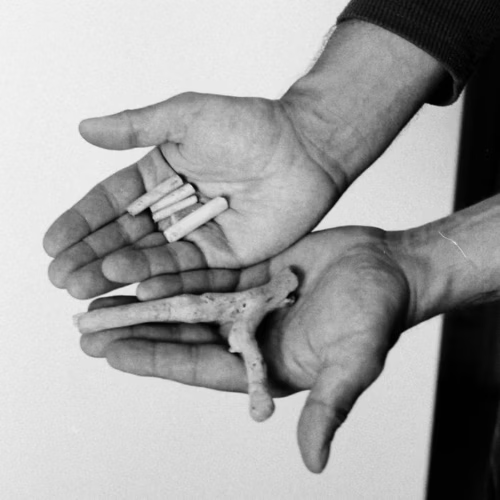
“The Quiet Was a Heron” stands out as the record’s most overt nod to traditional folk. Synth notes drift beneath Mackenzie‑Barrow’s tale of bones and rivers, a deceptively simple melody anchoring the song’s dreamlike atmosphere.
The album’s closer, “Stones In Your Bag,” conjures a late‑night Tom Waits barroom—half‑empty glasses, faint Christmas lights still flickering. Its twinkling keys and hushed delivery make for one of the most affecting closing moments you’ll likely hear this year. It’s a fitting end to a record that rises and retreats with impeccable precision, like a breath.
If the album lacks the urgency or punch of Divorce, that’s entirely by design. Book of Churches isn’t here to rush. It’s content to linger, to hum quietly in the background until you realize it’s been playing in your head all afternoon. It’s an engrossing, confident debut that proves Mackenzie‑Barrow’s songwriting thrives even when stripped bare. A record made for journeys—by foot or by memory—Book of Churches reminds us that sometimes the smallest moments carry the greatest weight.